
Exciting new techniques from woodturner Matthew Patrick
Updated: Feb 4
We are very excited to have some new pieces from Matthew Patrick, a woodturner whose fabulous work we have had in the Gallery for some time. Matthew uses various techniques including Shou Sugi Ban, carving, texturing and colouring and now he has added bleaching to his work and we have our first piece.


Bleaching involves the repeated application of a combination of chemicals that remove the natural colouring from the wood. The bleached piece we have is made from Cherry. Creating a piece like this takes many weeks or months. This piece was turned once and then frozen to allow it to dry more evenly. It was then allowed to dry, move and change shape naturally, before finishing. After drying it was carved around the neck. After carving, this piece was carefully sanded then to achieve the white colour it was coated with bleaching solution 8 times, leaving at least 24 hours in between each application and brushing and sanding lightly between applications. Bleached pieces are then cleaned with either water or a water and vinegar solution to neutralize the bleaching solutions. After a final sanding to remove any grain raised by the washing, the piece is ready for final finishing. Final finishing involved, in this case, buffing with a white diamond compound to produce a ceramic-like sheen.
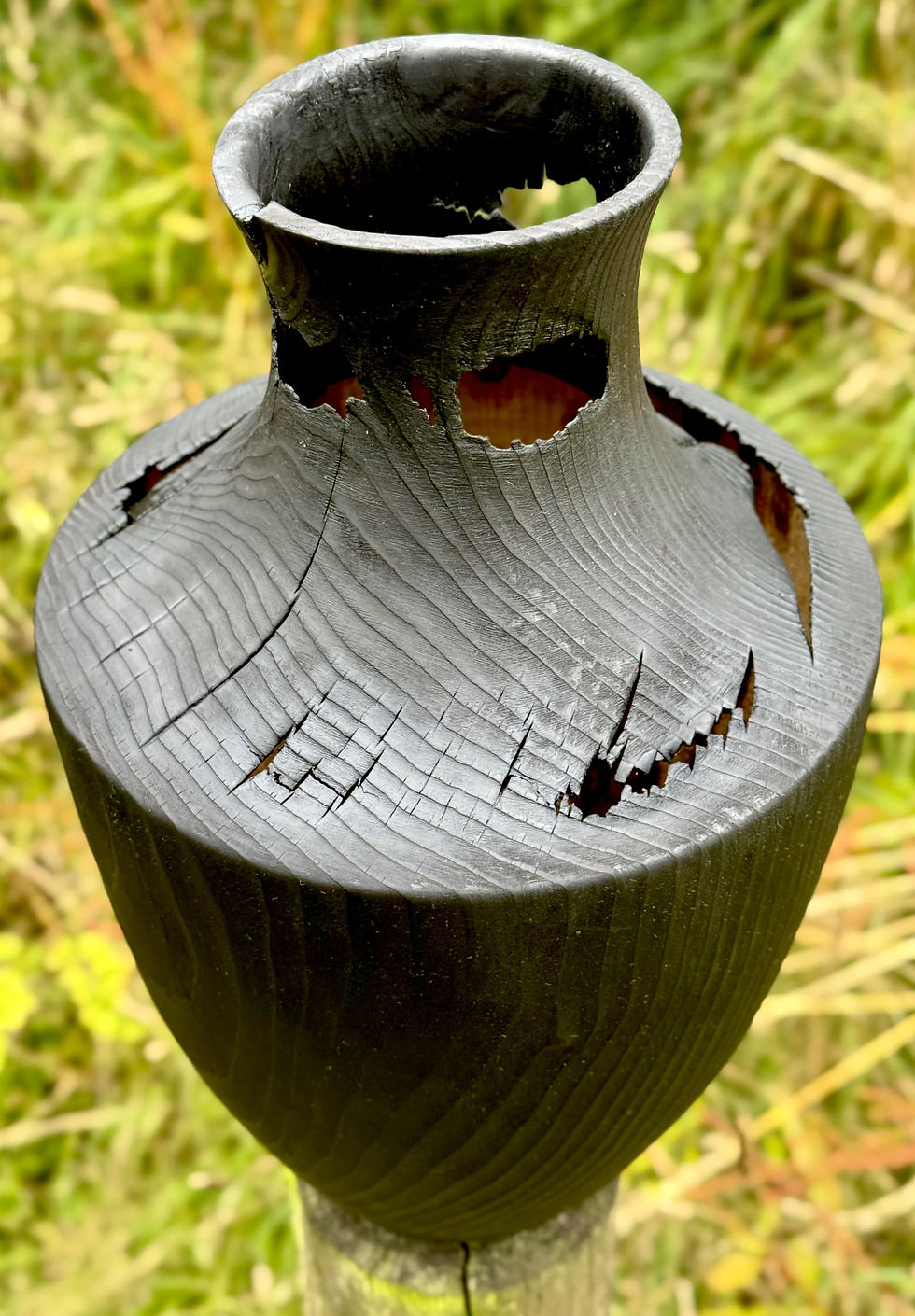
Matthew also uses a Japanese technique called Shou Sugi Ban. We have a number of his pieces in the Gallery. This is the traditional Japanese technique of wood preservation through charring the wood's surface with fire, creating a durable, weather-resistant, and insect-repellent finish that's visually striking. It is often used for siding and cladding, with various textures achieved through brushing and oiling to reveal rich grains or create a deep black look. In more recent years its use has also been pioneered in other areas, including furniture making and wood turning. Matthew can often be found outside his workshop, blowtorch in hand.



Some of our favourite pieces are those made from a burr (or burl). This is a knotty , irregular growth on a tree's trunk caused by stress of some kind - injury, insects or disease. These are difficult to work with but make the most beautiful pieces like the pieces above.
All of Matthew's hollowforms are hollowed through the opening at the top, with the aim of achieving an even, thin wall thickness throughout the vessel, aiming for a thickness of anywhere from 4-10mm depending on the size and shape of the vessel. Hollowing is technically challenging and involves the use of a range of specialist tools some of which are large and heavy to help manage vibration. At the other end of the spectrum, some tools are tiny. This process is even more difficult when working with burr wood because of the irregularities in the wood.
Matthew also carves and paints some of his pieces like this carved yew hollowform with a seaweed design and makes beautiful functional pieces like this fluted bowl.


Matthew works mainly with green or freshly cut wood. Selecting the right piece of wood involves looking at its external features, branches, knots, areas of decay, looking at the grain orientation and looking for any external signs of special grain qualities – figure – such as quilting or chatoyance. Once he has chosen the piece of timber, he sometimes rough shapes it into a cylinder with a chainsaw or mount it on the wood turning lathe as is. While he may have an idea of what sort of piece he wants to make, he never knows what he will find when he starts to work with the wood, and it always surprises. The finished shape is always born out of a dialogue between turner and wood and he tries to follow what the wood has to say as opposed to dictate.

Matthew lives on a smallholding in Cornwall, on the southern edge of Bodmin Moor. Surrounded by woodland, he works mainly with local wood from dead or dying trees, working with the wood to give it new form.
He is an approved AWGB (Association of Woodturners of Great Britain) tutor, but originally trained as a psychiatrist and psychoanalyst, and is particularly interested in the sculptural elements of turned pieces, especially Hollow Forms. Woodturning for him is an art form through which we may bring something from our internal landscape, complete with all its character and imperfections, into a tangible external form that can be shared, and that may just be recognised and resonate with others.


Comments